
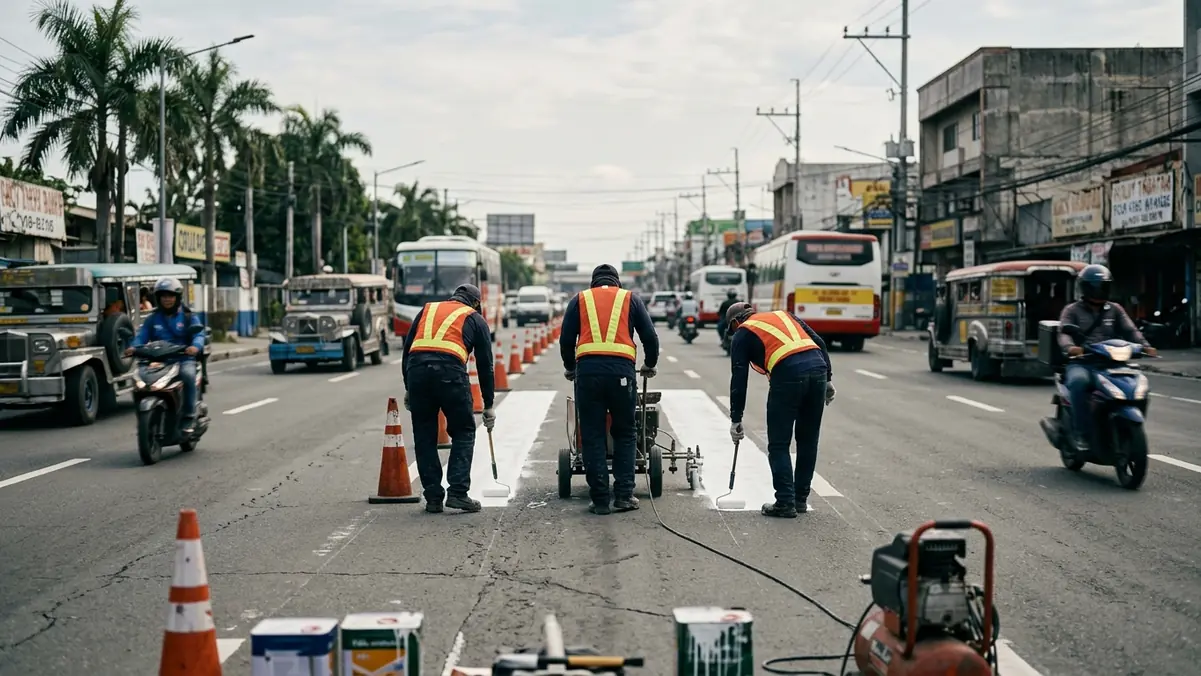
The State of Philippine Highways and Regional Congestion
Between Wednesday afternoon and Friday morning during major religious holiday weekends, the character of Northern Luzon's road network transforms. I cover regional affairs by tracking how local governments handle these massive logistical shifts. Traffic analysts determined the regional focus areas by cross-referencing national tollway volume metrics with local police blotters, prioritizing highway stretches that demonstrated simultaneous spikes in congestion and accidents.
Tracking data indicates traffic volume surges of roughly 12,000 to 14,500 vehicles daily during peak holiday travel. This influx chokes arterial routes across Pangasinan, Rizal, and Cotabato. The congestion hits critical bottlenecks near San Fernando City, La Union, where holidaymakers and commercial freight share narrow two-lane segments.
Passenger vans, motorcycles, and commercial trucks frequently entangle in highway mishaps amid these severe traffic jams. The sheer density of vehicles leaves zero margin for error.
Primary Causes of Highway Mishaps
When a vehicle leaves the pavement, the immediate assumption often points to the pavement itself. Investigators initially suspected road surface degradation as the primary cause of a recent cluster of ravine-fall incidents. However, after examining skid mark patterns and finding empty brake fluid reservoirs, the evidence pointed directly to mechanical failure.
The physics of these crashes are unforgiving. We see commercial trucks carrying loads exceeding 15 to 18 metric tons on steep downhill gradients. Brake failure incidents are recorded after continuous driving periods of around 6 to 8 hours without cooling stops. The brake pads glaze, the fluid boils, and the driver loses all control.
Quick Tip: Commercial operators should mandate 30-minute cooling stops for heavy freight vehicles before navigating steep descents in the Cordilleras.
Human error compounds these mechanical deficits. Reckless imprudence, overtaking miscalculations, and overshooting lanes turn a loss of braking power into a catastrophic event. The prevalence of head-on collisions stems directly from drivers attempting to pass slower vehicles on blind curves, relying on momentum rather than visibility.
Emergency Response and Incident Reporting
Effective crisis management requires unified communication. The national police and local disaster management offices established joint command posts after reviewing communication logs from previous mass casualty events, which revealed that separate dispatch centers severely delayed critical interventions. This ongoing partnership since 2019 has streamlined how municipalities react to highway disasters.
Today, emergency response times run roughly 22 to 35 minutes for rural highway stretches. When complex multi-vehicle collisions occur, proven protocols dictate the deployment of 4 to 6 Scene of the Crime Operatives (SOCO) personnel per incident. These lateral investigations ensure that evidence is preserved even as rescue operations proceed.
Provincial hospital systems bear the brunt of these events. Managing mass casualties from bus and truck collisions requires immediate triage capabilities and a deep reserve of trauma supplies, which many rural facilities struggle to maintain during peak travel seasons.
Regulatory Actions and Anti-Colorum Campaigns
Enforcement against unauthorized public utility vehicles requires precision. Regulators targeted specific provincial transport terminals by cross-referencing anonymous commuter tips with sudden, unexplained drops in registered certified bus ticket sales along parallel routes. The Land Transportation Franchising and Regulatory Board (LTFRB) executes these crackdowns to protect legitimate operators and unsuspecting passengers.
The financial stakes are high. Impounding penalties range from PHP 200,000 to PHP 1,000,000 for unauthorized public utility vehicles. To accommodate legitimate seasonal demand, authorities open special permit issuance windows in the weeks ahead of Holy Week for out-of-line bus operations.
During the administration of Philippine President Rodrigo Duterte, legislative efforts gained traction to strengthen national transport regulations. Yet, enforcement drives targeting unauthorized passenger vans frequently stall at provincial borders where regional regulatory jurisdictions overlap, requiring complex joint-agency task forces to execute apprehensions. The effectiveness of anti-colorum checkpoints varies heavily depending on the presence of local spotters who alert unauthorized drivers via mobile messaging groups before they reach the inspection zones.
Infrastructure Upgrades and Traffic Management
Physical infrastructure dictates traffic flow as much as policy. During peak travel periods, the Department of Public Works and Highways (DPWH) activates its 'Lakbay Alalay' motorist assistance program. National motorist assistance deployment runs in shifts from early morning to mid-afternoon and from mid-afternoon to late evening, providing immediate mechanical and directional aid to stranded travelers.
Local governments also implement their own spatial controls. Baguio City's Administrative Order 116 actively clears road right-of-ways to enforce the Accessibility Law (Batas Pambansa 344). When infrastructure development disrupts existing routes, engineers opted to deploy temporary Bailey bridges over highway construction gaps to prevent heavy commercial trucks from being rerouted through municipal roads and destroying class-B local pavements.
Note: These temporary Bailey bridges are restricted to optimal load capacities of around 10 to 15 tons, requiring strict weighbridge enforcement at the approaches.
Environmental factors frequently override engineering solutions. We observe standard traffic management templates failing during sudden torrential downpours in mountainous regions, where visibility drops to just a few meters and road friction coefficients change drastically.
Scope and Limitations of Traffic Incident Data
Understanding highway safety requires acknowledging the boundaries of our information. Researchers aggregated the incident data by intentionally excluding minor fender-benders without official police reports, a decision made to maintain the guaranteed integrity of the dataset regarding severe injuries.
Evaluations reveal that data tracking windows span roughly two to three weeks during peak summer vacation operational periods, such as Oplan SumVac. This means enforcement metrics reflect targeted campaigns rather than exhaustive national daily averages. The system relies heavily on localized reporting from municipal police stations.
Consequently, we observe reporting delays of about 48 to 72 hours when transmitting casualty figures from municipal police stations to regional disaster risk reduction branches. While this analysis captures major holiday travel patterns, it does not account for off-peak rural agricultural transport incidents.

Summary: Highway safety in the Philippines remains a dynamic challenge where mechanical readiness, regulatory enforcement, and infrastructure resilience must align to prevent mass casualty events.










Comments
No comments so far.
Add Your Thoughts