

Under Article VII, Section 22 of the 1987 Philippine Constitution, the President must submit the proposed national spending plan to Congress within 30 calendar days from the opening of every regular session on the fourth Monday of July. That constitutional deadline kicks off a massive legislative spectacle, yet most taxpayers only pay attention when a controversial fund dominates the evening news. By the time a questionable project surfaces in a post-year audit, the money is gone. Tracking public taxes effectively requires understanding how the fiscal machinery actually operates from the executive drafting table down to the barangay.
From the President’s Desk to the Barangay: The Four-Phase Fiscal Cycle
Public finance in the Philippines runs on four distinct phases: Budget Preparation, Budget Legislation (Authorization), Budget Execution, and Budget Accountability. Treating this cycle as a neat, sequential relay race is a mistake. Three of the four budget phases run concurrently every August: line agencies execute the current year's General Appropriations Act (GAA), Congress deliberates next year's National Expenditure Program (NEP), and Commission on Audit (COA) auditors finalize Annual Audit Reports for the prior fiscal year.
Why does this overlapping calendar matter to a citizen trying to track a farm-to-market road or a regional hospital upgrade?
Consider how the timeline compressed in 2019. Executive budget managers and legislative leaders collided over whether to extend infrastructure appropriations across two full fiscal years or shift to a strict annual cash-based budgeting system. Later that year, President Rodrigo Duterte codified the annual cash-based regime under Executive Order No. 91. Under this rule, agencies must obligate and disburse funds within the 12-month fiscal year plus a three-month Extended Payment Period. An agency cannot sit on idle appropriations forever. If you wait until December to check whether a local road project in San Fernando City, La Union was funded in the current year's budget, the window to bid, build, and pay for that project has already slammed shut, and lawmakers have already locked in the allocations for the following year.
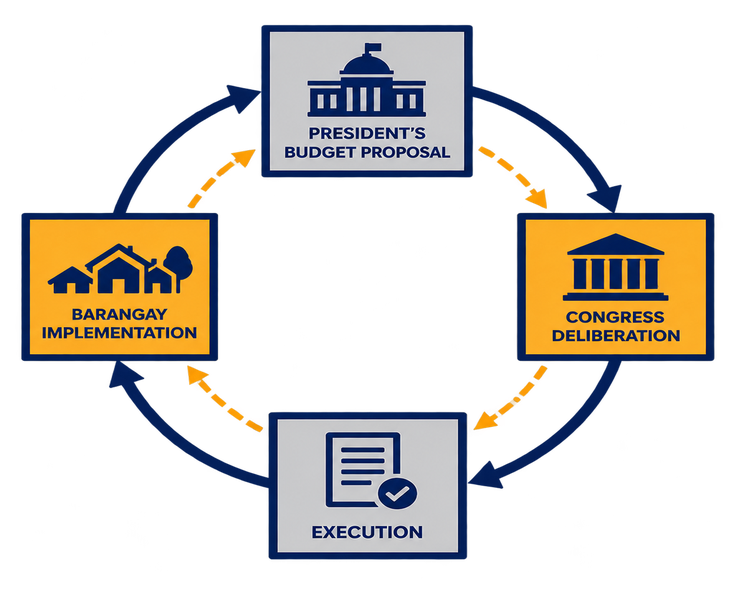
Decoding the Executive Proposal: Budget Calls, Tier 1 vs. Tier 2, and the NEP
Months before the President delivers the State of the Nation Address, the macroeconomic boundaries of the budget are already set. Every December, the Development Budget Coordination Committee (DBCC)—composed of the Department of Budget and Management (DBM), the Department of Finance, the National Economic and Development Authority, and the Bangko Sentral ng Pilipinas—establishes the macroeconomic assumptions for the coming cycle. They fix inflation bands, Dubai crude oil prices per barrel, and foreign exchange rates, which then trigger the January National Budget Call.
Historically, line agencies packed their baseline budget requests with unvetted capital projects, creating a massive evaluation bottleneck. To stop this practice, the DBM split budget evaluation into two administrative windows under the Two-Tier Budgeting Approach (2TBA):
- Tier 1 (Ongoing Operations): This tier locks in forward estimates for existing programs, regular operating requirements, and already-approved multi-year projects. Tier 1 Technical Budget Hearings take place over on the order of 3 to 4 weeks in March and April.
- Tier 2 (New and Expanded Spending): Once baseline costs are settled, agencies compete for remaining fiscal space to fund brand-new proposals and expanded infrastructure projects. Tier 2 hearings run in May and June, leading straight into the Cabinet presentation in early July.
When the executive branch hands its proposal to Congress, it arrives as a towering stack of technical documents. Citizens need to know which volume answers which question. The National Expenditure Program (NEP) contains the granular line-item proposals for every central department, bureau, and office. The Budget of Expenditures and Sources of Financing (BESF) lays out the macroeconomic framework, revenue projections, and debt servicing schedules. For voters who do not want to parse thousands of pages of accounting codes, the DBM publishes the People's Proposed Budget, a plain-language summary of fiscal priorities.
Even with these volumes in hand, national budget tracking through the NEP and BESF covers central line agency allotments and automatic National Tax Allotment (NTA) transfers, whereas tracking how a municipality or city spends its NTA share requires inspecting separate Local Sanggunian appropriation ordinances and barangay Annual Investment Programs.
La Union Fiscal Boundary: Central agency allocations for a national highway bypass in San Fernando City, La Union appear in the DBM's national portals, but auditing how the city hall spends its own National Tax Allotment requires pulling local Sangguniang Panlungsod ordinances.
Inside the Legislative Mill: GAB Hearings, Bicameral Realignments, and Special Funds
Under Article VI, Section 24 of the Constitution, the General Appropriations Bill (GAB) must originate exclusively in the House of Representatives. The House Committee on Appropriations conducts agency briefings and plenary debates from August to early October before transmitting the approved bill to the Senate Committee on Finance. Throughout these public hearings, lawmakers grill cabinet secretaries on delayed projects and underspending.
Yet the real fiscal reshaping happens out of public view. Following the November 2013 Supreme Court ruling in Belgica v. Ochoa that declared post-enactment legislative lump-sum funds unconstitutional, legislators shifted how they identify local projects. Instead of waiting until the budget is signed to request project releases, lawmakers now submit formal committee-level amendments during the legislative process.
I have watched hours of public committee hearings where lawmakers debate minor operational expenses, only to see billions of pesos shifted silently during the final reconciliation stage. After the Senate passes its version of the GAB, conflicting provisions between the House and Senate bills go to the Bicameral Conference Committee ('Bicam'). These reconciliations take place over a compressed window of in the vicinity of 5 to 14 days in late November or early December, where line-item realignments and Unprogrammed Appropriations ceilings are finalized behind closed doors—legislative records of budgets under President Rodrigo Duterte show as much.
To spot where discretionary power hides in the GAB, compare how funds are structured across two main categories:
- Regular Agency Budgets: Assigned directly to specific departments (such as Education, Health, or Public Works) with defined performance targets, regional breakdowns, and strict Tier 1 and Tier 2 vetting.
- Special Purpose Funds (SPFs): Lump-sum allocations managed centrally or released upon specific triggers. These include the Contingent Fund for urgent, unforeseen needs; the Miscellaneous Personnel Benefits Fund (MPBF) for unfilled positions and salary adjustments; and Unprogrammed Appropriations, which provide standby authority to spend only when revenue collections exceed targets or new foreign loans are secured.
When the Bicameral committee inflates Unprogrammed Appropriations to make room for favored infrastructure insertions, it creates a shadow budget that bypasses the rigorous Tier 2 evaluation conducted by the DBCC back in May.
Following the Money After Enactment: GAA, SARO, and Cash Allocations
When the President signs the General Appropriations Act (GAA) into law at the end of December, not a single peso moves into an agency's bank account. A common misconception among local watchdogs is that an enacted line item in the GAA equals cash on hand. In reality, Philippine budget execution separates fiscal permission into three distinct steps: Appropriation (legislative authorization in the GAA), Allotment (obligational authority to sign contracts), and Cash Allocation (authority to pay suppliers).
Agency procurement officers determine whether an enacted line item can proceed immediately to bidding in January by checking its classification in the GAA release schedules. Under the GAA-as-Allotment-Order policy, items categorized under 'For Comprehensive Release' (FCR) use the enacted GAA itself as the obligational authority on January 2. Conversely, items tagged 'For Later Release' (FLR)—which include confidential funds, centrally managed items, and Special Purpose Funds—are held back until the agency submits special budget requests and the DBM issues a Special Allotment Release Order (SARO).
Once an agency holds an allotment (via FCR or SARO) and signs a contract with a private supplier, it still cannot write a check until the DBM issues a Notice of Cash Allocation (NCA). The NCA is credited to Modified Disbursement System (MDS) sub-accounts at government servicing banks. To enforce strict cash discipline, NCAs lapse at the end of every calendar quarter—or on the last working day of each month for specific trust receipts—reverting unspent cash authority back to the Bureau of the Treasury.
Why do public hospitals still run out of supplies or road projects stall mid-year if the allotments are released on January 2? The bottleneck lies in procurement mechanics. Standard competitive public bidding under the Government Procurement Reform Act (RA 9184) requires between 28 and 136 calendar days from the advertisement of the Invitation to Bid to the Notice to Proceed. When agencies fail to conduct Early Procurement Activities (EPA) during the preceding fourth quarter while the GAB is still in Congress, they suffer a severe mid-year disbursement lag, forcing them into frantic catch-up plans by the third quarter just to beat the quarterly NCA lapse.
| Document / Instrument | Issuing Body | Budget Phase | Operational Function for Citizen Tracking |
|---|---|---|---|
| National Expenditure Program (NEP) | Department of Budget and Management (DBM) | Preparation / Legislation | Reveals the President's original baseline and Tier 2 project proposals before congressional edits. |
| General Appropriations Bill (GAB) | House of Representatives & Senate | Legislation | Tracks committee amendments and Bicameral Conference Committee insertions prior to enactment. |
| General Appropriations Act (GAA) | Congress / Signed by President | Execution | Serves as the enacted law and immediate allotment authority for 'For Comprehensive Release' (FCR) items on January 2. |
| Special Allotment Release Order (SARO) | Department of Budget and Management (DBM) | Execution | Unlocks 'For Later Release' (FLR) items and Special Purpose Funds so agencies can legally enter into contracts. |
| Notice of Cash Allocation (NCA) | Department of Budget and Management (DBM) | Execution | Authorizes government servicing banks (MDS sub-accounts) to release actual cash to pay contractors before quarterly lapses. |
| Annual Audit Report (AAR) | Commission on Audit (COA) | Accountability | Documents post-audit findings, including AOMs, Notices of Suspension, and Notices of Disallowance. |
How to Audit Public Spending Using DBM Portals and COA Reports
Publicly accessible government portals allow citizens to check whether a public project in their community is legitimate. Follow this step-by-step verification process:
- Photograph the Project Signboard: Every public infrastructure project—whether a flood control dike or a barangay health station, is required to display a standard tarpaulin listing the project title, implementing agency, contractor, contract cost, and start/completion dates.
- Cross-Reference the GAA and SARO Portals: Open the DBM's online transparency portal and check the enacted GAA volumes for the implementing agency (e.g., Department of Public Works and Highways) to see if the project appears under the regular FCR schedule. If the project does not appear in the regular regional breakdown, check the DBM's SARO and NCA release database to see if it was funded mid-year via Special Purpose Funds or Unprogrammed Appropriations.
- Verify Procurement Timelines: Match the contract award date on the signboard against the NCA release dates. If an agency claims a project is delayed due to 'lack of funds' despite an active NCA on the DBM portal, the failure is an internal agency procurement or execution bottleneck.
- Inspect the COA Annual Audit Report (AAR): In the year following execution, pull the agency's or municipality's AAR from the Commission on Audit website and search the 'Observations and Recommendations' section for the project name or contract number.

When reading COA reports, citizens and journalists frequently misinterpret audit terminology, treating every preliminary query as proven graft. When a COA resident auditor uncovers irregular, unnecessary, excessive, extravagant, or unconscionable expenditures during post-audit, they follow a strict administrative escalation sequence:
- Audit Observation Memorandum (AOM): This is a preliminary inquiry. The auditor spots a deficiency or documentation gap and issues an AOM requesting agency management to explain or justify the transaction. An AOM is an opportunity to reply, not a final ruling of theft.
- Notice of Suspension (NS): If the agency's response to the AOM is unsatisfactory or missing required receipts, the auditor escalates the issue to a Notice of Suspension, temporarily halting the transaction's approval. Accountable officers served with a Notice of Suspension have exactly 90 calendar days from receipt to submit missing justifications or settle the deficiency before the suspension automatically matures into a disallowance.
- Notice of Disallowance (ND): This is a formal disapproval of the expenditure. Once issued, the transaction is declared illegal or improper, and the named public officers and private contractors are held personally liable to refund the exact amount to the public treasury. Under Section 48 of Presidential Decree No. 1445, aggrieved agency officials have 6 months (180 calendar days) from receipt of a Notice of Disallowance to file an appeal with the COA Regional Director or Cluster Director before the personal liability becomes final and executory.
Audit Escalation Clock: A Notice of Suspension gives public officials a strict 90-day window to produce missing receipts before the finding hardens into a legally enforceable Notice of Disallowance.
While COA auditors perform vital constitutional work, relying on post-audit reports to safeguard public taxes is a losing strategy. By the time an Audit Observation Memorandum matures into a final Notice of Disallowance and survives the 180-day appeal window, years have passed and the physical concrete has already cracked. Citizens, investigative journalists, and civil society coalitions must stop waiting for post-year COA disallowances to spark public outrage. Redirect your investigative energy upstream to late November: monitor the House 'small committee' amendments, demand public line-item disclosures during the Bicameral Conference Committee window, on the order of 5 to 14 days, and challenge the expansion of Unprogrammed Appropriations before the President signs the GAA into law.












Comments
No comments so far.
Add Your Thoughts