
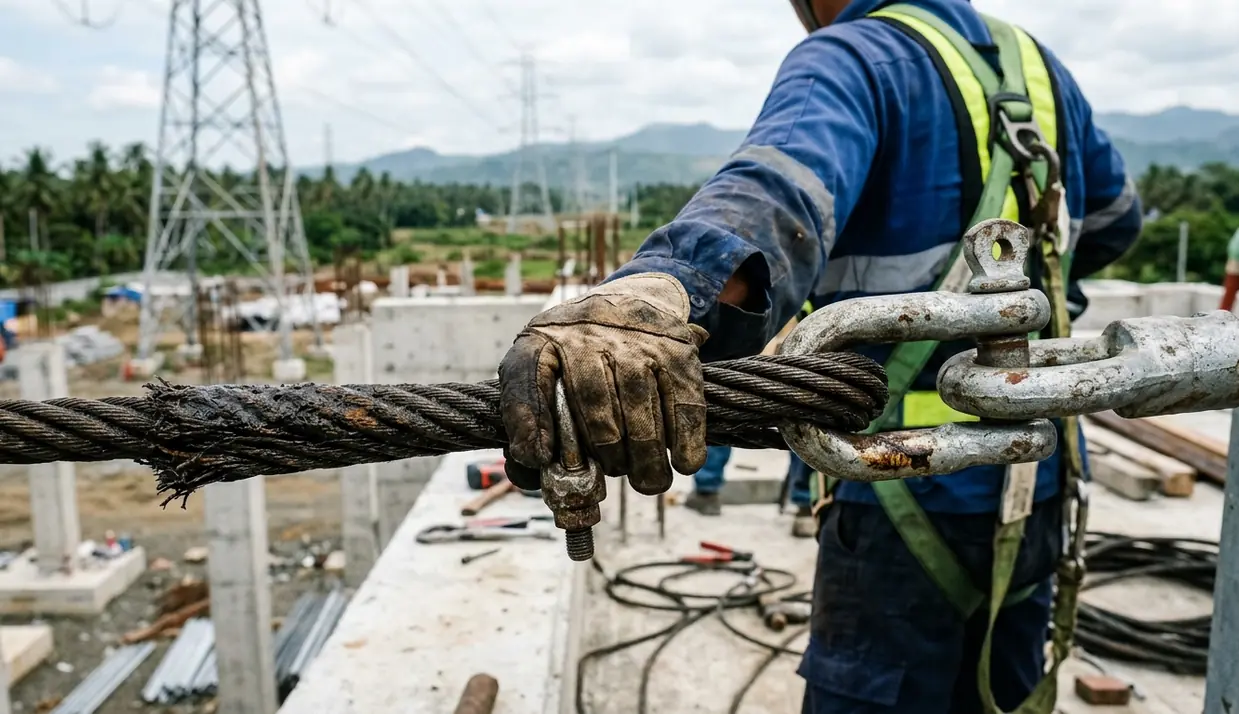
The State of Philippine Infrastructure and Power
Grid operators determine alert statuses by calculating the difference between available generating capacity and projected peak demand. When operating margins drop below the 668-megawatt threshold of the largest grid asset, the National Grid Corporation of the Philippines (NGCP) issues a yellow alert. For regional electric cooperatives like ISELCO and BENECO, this translates directly into rotational brownouts lasting between 2 to 4 hours per distribution feeder.
These power supply deficiencies cascade into other sectors—disrupting both commercial output and public services. Legislative inquiries and international reports frequently highlight how unstable power grids exacerbate challenges in digital connectivity. Without a reliable energy foundation, modernizing other public works remains structurally constrained.
Note: The historical context of power supply deficiencies reveals a persistent gap between peak demand projections and actual generation capacity during the dry season.
Analyzing the Shift Toward Comprehensive Development
During the administration of Rodrigo Duterte: President of the Philippines, regional planners shifted from approving isolated municipal projects to requiring integrated master plans. The National Economic and Development Authority (NEDA) and the Department of Transportation (DOTr) evaluate proposals based on their capacity to absorb population spillover from the capital.
Master-Planned Communities
This transition is evident in developments like the Clark Green City project spearheaded by the BCDA. Integrating regional development investment plans requires extensive coordination across multiple government tiers. Tracking data indicates review cycles spanning roughly 14 to 18 months for comprehensive land use plan integration. The ultimate goal is addressing urban congestion and disaster resilience, specifically targeting population density reductions of around 150 to 200 persons per hectare in congested urban centers.
Energy Infrastructure: Balancing Baseload and Renewables
The expansion of renewable energy in the Philippines requires strong transmission networks. Wind farms in Ilocos Norte, developed by Northwind and Alternergy, generate significant power, but delivering that electricity to demand centers poses engineering hurdles. Planners opted to upgrade the northern transmission corridor to accommodate incoming wind capacity.
The NGCP executed the Santiago-Gamu-Tuguegarao 230kV line project by upgrading existing lattice towers to support 230kV double-circuit lines. This infrastructure spans a distance of approximately 115 to 122 kilometers across mountainous terrain. Meanwhile, the development of proven baseload power capabilities continues with facilities like the Therma South Inc. (TSI) plant in Mindanao.
Balancing these sources is critical. Grid operators must account for the variation in grid stability depending on the seasonal output of run-of-river hydro facilities. The Department of Energy oversees this delicate mix of baseload reliability and renewable integration.
Paving the Way: Transport and Public Works
Major road networks and expressways, including the NLEX-SLEX Connector Road and TPLEX, dominate national headlines. Yet provincial infrastructure initiatives like the Provincial Road Network Development Plan (PRNDP) in Ilocos Norte and the KALSADA program in Isabela dictate local economic momentum in hubs like San Fernando City, La Union.
Engineering for Local Realities
Public works engineers prioritize provincial road rehabilitation by cross-referencing daily traffic volumes with agricultural harvest schedules. This ensures optimal heavy machinery deployment avoids peak monsoon seasons and harvest transport windows. Construction standards mandate pavement thickness specifications requiring around 280mm to 300mm of Portland cement concrete, based on available benchmarks. Engineers strictly monitor curing periods between 14 to 21 days before opening these arteries to heavy vehicular traffic.
Localized engineering is paramount. Reporting confirms the failure of standardized road designs in areas with high soil liquefaction potential, forcing a rethink of mass transit solutions. Projects like the LRT-2 extension and the Automated Guideway Transit (AGT) feasibility study in Baguio must adapt to these specific geological realities.
Upgrading Digital Connectivity and Telecommunications
Policy directives initiated by Rodrigo Duterte: Philippine President emphasized the implementation of the National Broadband Program by the DICT to improve internet services outside major metropolitan hubs. Telecommunications regulators select public Wi-Fi deployment sites by mapping geographically isolated and disadvantaged areas against the presence of stable municipal power grids. They prioritize locations capable of sustaining continuous equipment operation.
The expansion of premium open national WiFi services, such as the Juan, Konek! project, relies on precise technical parameters. Administrators allocate guaranteed bandwidth caps of roughly 2 Mbps to 5 Mbps per concurrent user session. Technicians install access points with a line-of-sight range of around 150 to 200 meters in open plazas. These foundational steps are necessary as telecommunications providers prepare for 5G and IoT transformation across the archipelago.
Development Limitations and Community Opposition
Infrastructure expansion frequently intersects with environmental concerns and indigenous rights. The necessity of the Free and Prior Informed Consent (FPIC) process is evident in projects affecting indigenous groups, such as the Bugkalot tribe. The indigenous commission mandates a multi-stage consensus-building process.
Navigating Environmental and Social Friction
Developers must present certified environmental impact assessments in local dialects during community assemblies before securing approval. Field-based investigations require an estimated 120 to 180 days to complete. Regulators enforce mandatory cooling-off periods of 10 to 15 days between community assemblies to ensure uncoerced deliberation. While these regulatory frameworks are strict, the mandatory consensus-building process strictly applies to recognized ancestral domains, leaving communities outside these designated zones to rely on standard environmental compliance hearings.
Local opposition to coal-fired power plants, highlighted by the Save Sual Movement, underscores the friction between baseload requirements and environmental health. Similar scrutiny applies to engineered sanitary landfills (ESL) and watershed management plans, demanding a careful balance between modernization and ecological preservation.
Summary: Advancing national infrastructure requires navigating complex geological, social, and regulatory conditions, moving beyond isolated projects toward integrated, resilient master planning.







Comments
No comments so far.
Add Your Thoughts